
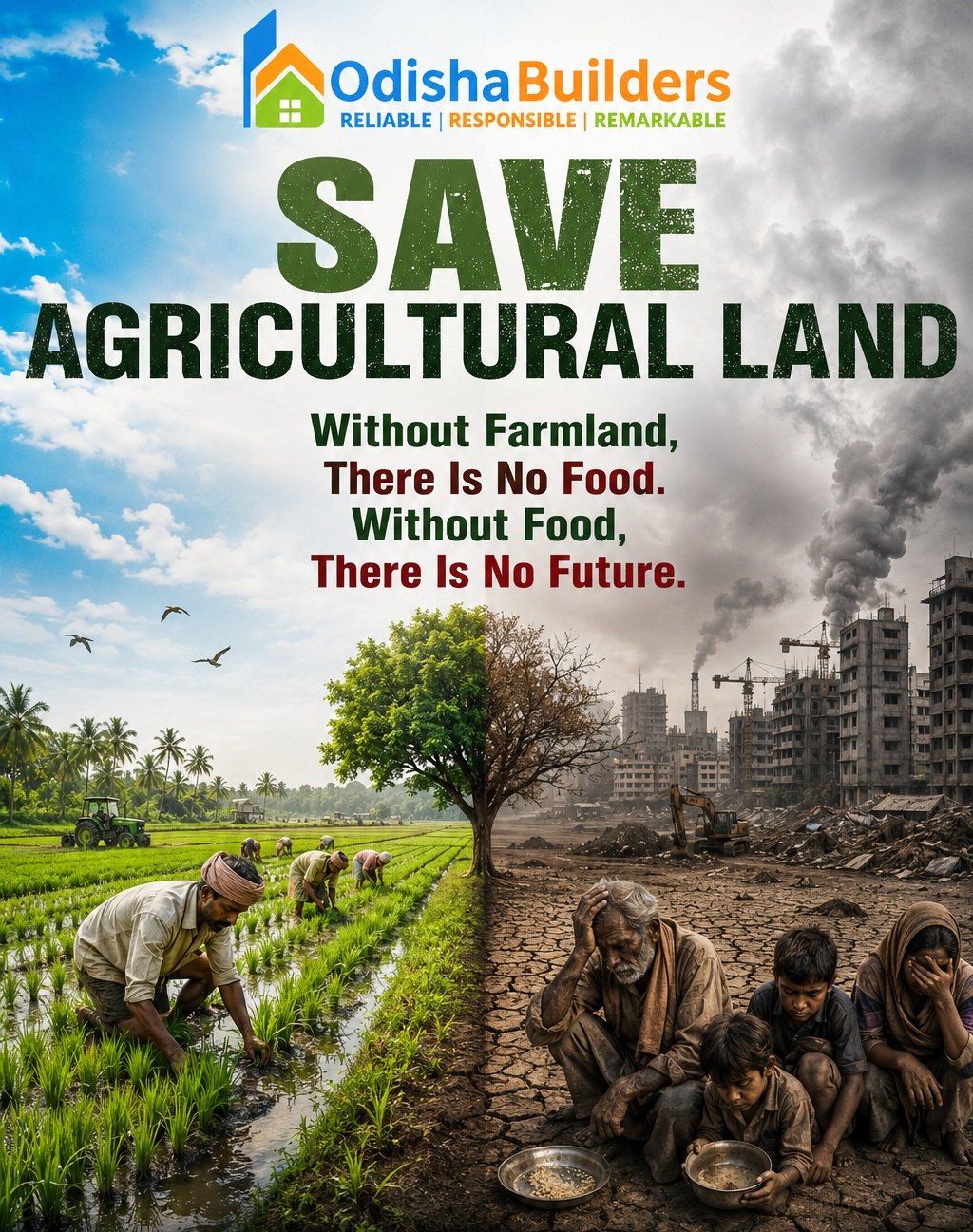
Agricultural land is the foundation of human civilisation. Every grain of rice, wheat, vegetables, fruits, and milk we consume begins with fertile farmland. Yet across India and many parts of the world, productive agricultural land is rapidly disappearing due to urbanisation, industrial expansion, highways, commercial projects, and unplanned development.
As cities continue to grow, thousands of acres of fertile farmland are converted into residential colonies, shopping complexes, factories, and concrete structures every year. While development is necessary, losing fertile agricultural land at an uncontrolled pace threatens our food security, economy, environment, and future generations.
The question we must ask ourselves is simple:
What will happen if agricultural land continues to disappear?
The answer affects every person on Earth.
Agricultural land is much more than empty fields. It provides:
Without healthy farmland, no country can remain food secure.
The biggest consequence is a severe food shortage.
No farmland means:
As agricultural production decreases, food demand continues to rise because the population keeps increasing.
Eventually, demand becomes greater than supply.
This leads to food scarcity.
When production decreases, prices automatically increase.
Imagine:
Poor and middle-class families suffer the most.
Inflation affects every household.
If a country cannot grow enough food, it must import food from other countries.
This creates several problems:
A nation that cannot feed itself becomes vulnerable during wars, pandemics, or global crises.
Millions of farmers depend entirely on agriculture.
When farmland is converted into buildings:
This weakens rural economies and increases unemployment.
Agricultural land naturally absorbs rainwater.
Concrete roads and buildings prevent water from entering the ground.
As farmland disappears:
Cities already struggling with water shortages will face even greater challenges.
Healthy farmland and trees absorb carbon dioxide from the atmosphere.
When agricultural land is replaced with concrete:
This contributes directly to global warming.
Farmland supports countless living organisms:
Destroying farmland destroys their habitat.
Without pollinators like bees, crop production also declines.
Agricultural fields naturally absorb rainwater.
Concrete surfaces do not.
When farmland disappears:
Many cities already experience flooding after heavy rainfall due to excessive construction.
Agricultural fields and surrounding trees improve air quality.
Replacing them with buildings and industries leads to:
The result is unhealthy living conditions.
Today's decisions shape tomorrow's world.
If we continue destroying fertile farmland, future generations may face:
Protecting farmland today is an investment in tomorrow.
Several factors contribute to farmland loss:
Development is important, but it should not come at the cost of fertile agricultural land.
Everyone has a role to play.
Construction is necessary, but responsible development is equally important.
Developers should:
Balanced development protects both economic growth and food security.
Economic growth and agriculture do not have to compete.
A sustainable approach includes:
Development should happen without sacrificing the land that feeds us.
One acre of fertile land can produce food for many families each year.
When that acre is replaced with concrete, it can no longer grow crops for generations.
Farmland is a limited resource. Once fertile soil is permanently covered by buildings and roads, restoring it is extremely difficult and often impossible.
Protecting agricultural land is not only the responsibility of farmers or governments. Every citizen, planner, builder, and policymaker has a role.
Choosing sustainable development, reducing food waste, supporting local agriculture, and protecting fertile land are actions that help ensure a secure future.
Agricultural land is the backbone of our survival. Without fertile farmland, there is no food, no farming, and no long-term food security. The disappearance of agricultural land can lead to food shortages, rising prices, water crises, environmental degradation, loss of biodiversity, and economic instability.
Development is essential, but it must be balanced with the protection of productive farmland. By planning wisely, supporting farmers, and preserving fertile land, we can build prosperous cities while ensuring that future generations continue to have access to safe, affordable, and nutritious food.
Final Thought
"Save Agricultural Land Today, So Future Generations Can Eat Tomorrow. Development Can Wait—Food Cannot."

Information 5 min read
Read →
Information 5 min read
Read →
Guide 5 min read
Read →
Tips 5 min read
Read →
Tips 5 min read
Read →
Guide 5 min read
Read →
Guide 5 min read
Read →
Information 5 min read
Read →
Information 5 min read
Read →
Guide 5 min read
Read →
Guide 5 min read
Read →
Guide 5 min read
Read →
Guide 5 min read
Read →
Analysis 5 min read
Read →
Information 5 min read
Read →
Guide 5 min read
Read →
Guide 5 min read
Read →
Guide 5 min read
Read →
Guide 25 min read
Read →
Guide 5 min read
Read →