loading
GUIDE 06 October, 2026 5 min read

Types of Sand Used in Construction and Their Uses in Odisha

Sand is one of the most important construction materials used in house construction, building construction, renovation, RCC work, plastering, brickwork, flooring, concrete and infrastructure projects. In Odisha, the choice of sand can vary depending on the type of work, availability, transportation distance, grading, cleanliness and project location.

Odisha has extensive river systems and sand deposits. The Odisha Government's 2024 guidelines note that sand deposits occur in river systems, sand dunes and beaches, and identify major river systems including the Mahanadi, Brahmani, Baitarani, Budhabalang, Subarnarekha, Rushikulya, Bansadhara, Nagabali, Indravati, Ong and Tel. 

Odisha currently has 30 districts, 58 sub-divisions, 317 tahasils and 314 blocks, so construction-sand requirements can differ significantly between coastal, central, western and southern parts of the state. 


1. What Is Construction Sand?

Construction sand is a granular material primarily composed of small mineral particles. It is used with cement, aggregate and water to make concrete, mortar and plaster.

The quality of sand directly affects:

  • Concrete strength
  • Plaster quality
  • Brick masonry
  • Mortar bonding
  • Workability
  • Shrinkage and cracking
  • Surface finishing
  • Long-term durability

Therefore, choosing sand only on the basis of price or colour is not recommended.


2. Major Types of Sand Used in Construction

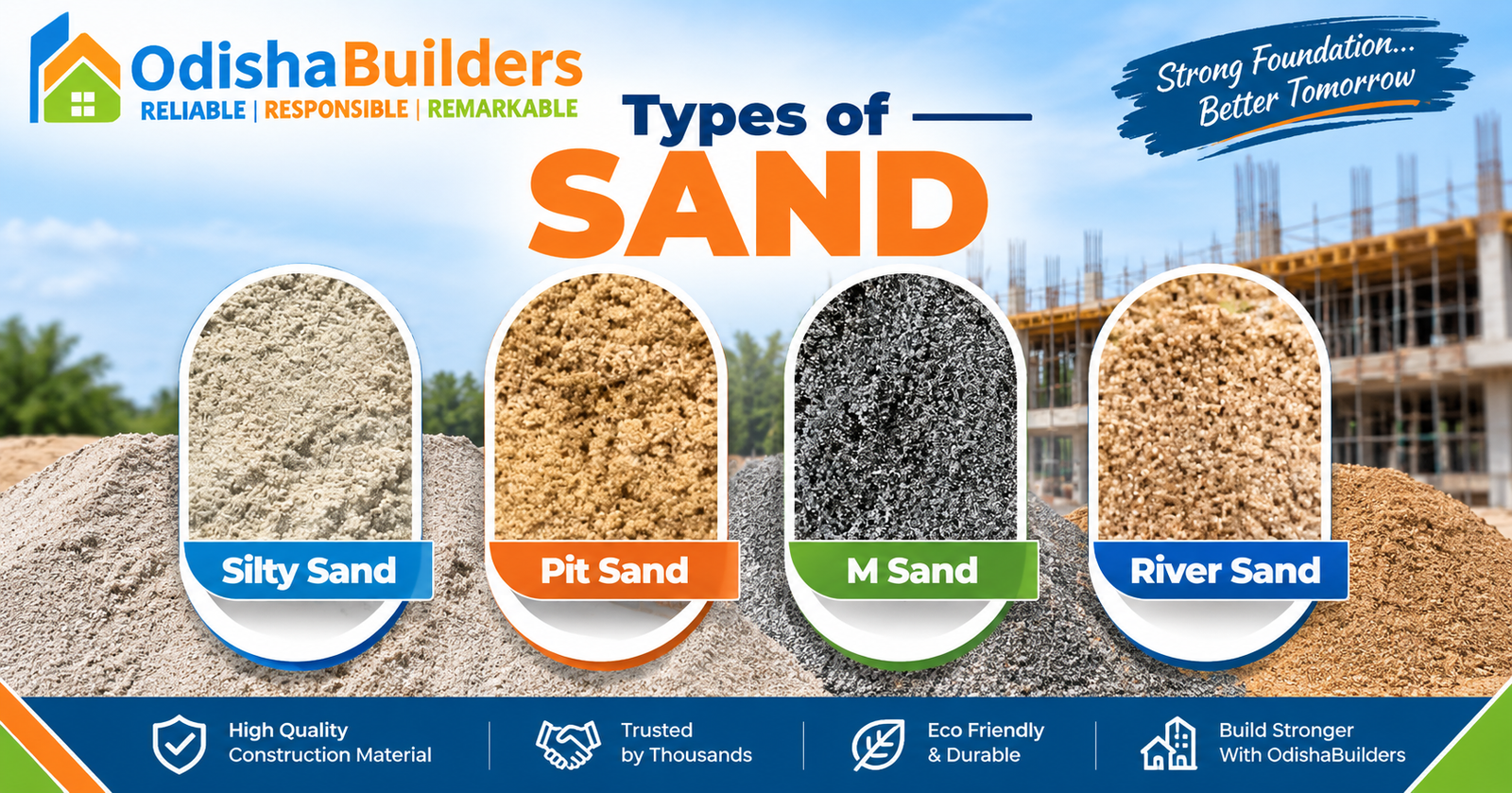
The main types of sand commonly considered for construction in Odisha are:

  1. River Sand
  2. Manufactured Sand / M-Sand
  3. Crushed Stone Sand
  4. Pit Sand
  5. Coarse Sand
  6. Fine Sand
  7. Plastering Sand
  8. Concrete Sand
  9. Fill Sand
  10. Beach/Sea Sand – generally unsuitable for normal RCC and masonry unless properly processed and specifically approved

Let's understand each type.


3. River Sand

River sand is naturally deposited sand obtained from river systems. It has traditionally been one of the most widely used construction sands.

In Odisha, river systems are an important source of natural sand deposits. The State's sand-quarrying guidelines specifically note that river sand is primarily used for roads, railways, industries and buildings. OSPCB

Common Uses

River sand can be used for:

  • RCC concrete
  • PCC work
  • Brick masonry
  • Block masonry
  • Plastering
  • Flooring base
  • Foundation-related works
  • Mortar
  • General building construction

Advantages

  • Naturally rounded particles
  • Good workability
  • Suitable grading when properly sourced
  • Widely familiar to construction workers
  • Suitable for several traditional applications

Important Point

River sand should be sourced legally and should be tested for silt, clay, organic impurities, grading and other relevant properties before important structural work.


4. Manufactured Sand / M-Sand

M-Sand, or manufactured sand, is produced by crushing and processing suitable rock or stone into sand-sized particles.

It is increasingly considered as an alternative to natural sand where suitable quality material is available.

Uses of M-Sand

M-Sand can be used for:

  • RCC concrete
  • PCC
  • Foundation concrete
  • Columns
  • Beams
  • Slabs
  • Footings
  • Brickwork
  • Blockwork
  • Paver-related applications
  • Some plastering applications, depending on grading and specification

Advantages

  • Manufactured under controlled processing
  • Can provide consistent grading when properly produced
  • Reduces dependence on natural river sand
  • Can be available near stone-crushing areas

Important

Not every M-Sand product has the same quality. Before using it for structural concrete, check:

  • Particle size distribution
  • Fineness
  • Silt/fines content
  • Shape of particles
  • Moisture
  • Cleanliness
  • Applicable project specifications

5. Crushed Stone Sand

Crushed stone sand is produced by crushing suitable rock and processing the resulting material into sand-sized particles.

It is closely related to manufactured sand but terminology and production specifications can vary.

Uses

It may be used for:

  • Concrete
  • PCC
  • Masonry
  • Road construction
  • Paver blocks
  • General civil construction

It is particularly relevant in areas where suitable hard rock and crushing facilities are available.


6. Coarse Sand

Coarse sand contains comparatively larger sand particles.

It is useful where higher workability and a suitable granular structure are required.

Uses

  • Concrete
  • RCC
  • PCC
  • Brick masonry
  • Block masonry
  • Flooring base
  • Construction mortar

For concrete, the sand should be selected according to the concrete mix design and required grading rather than simply choosing the "coarsest" sand available.


7. Fine Sand

Fine sand contains smaller particles than coarse sand.

Uses

Fine sand may be used for:

  • Certain plastering applications
  • Finishing work
  • Mortar
  • Filling
  • Some non-structural applications

However, excessively fine or silty sand can increase water demand and may negatively affect the performance of concrete or mortar.


8. Plastering Sand

Plastering sand is selected for its suitability for producing a smooth and workable plaster mix.

Used For

  • Internal wall plaster
  • External wall plaster
  • Ceiling plaster
  • Repair plaster
  • Renovation work
  • Finishing work

For plastering, sand should generally be clean, properly graded and free from excessive clay, silt and organic matter.

The exact grading should be selected according to the plaster specification and desired finish.


9. Concrete Sand

Concrete sand is sand selected and graded specifically for use in concrete.

It is generally expected to provide appropriate:

  • Particle-size distribution
  • Cleanliness
  • Strength characteristics
  • Workability
  • Compatibility with cement and coarse aggregate

Used For

  • Footings
  • Columns
  • Beams
  • Slabs
  • RCC structures
  • PCC
  • Foundations
  • Other structural concrete

For structural concrete, sand should not be selected solely by visual appearance. Testing and the project's concrete mix requirements are more important.


10. Fill Sand

Fill sand is generally used for filling and leveling rather than structural concrete.

Uses

  • Site leveling
  • Filling low areas
  • Backfilling
  • Around certain construction areas
  • Under some non-structural applications
  • Landscaping-related works

The material should be suitable for the intended filling application and properly compacted where required.


11. Beach or Sea Sand

Odisha has a long coastline, including coastal areas around Balasore, Bhadrak, Kendrapara, Jagatsinghpur, Puri, Khordha and Ganjam.

However, beach sand should not automatically be treated as ordinary construction sand.

Sea sand can contain salt and other impurities that may create problems for reinforced concrete and metal components.

Why It Can Be Problematic

Salt contamination can contribute to:

  • Reinforcement corrosion
  • Durability problems
  • Surface defects
  • Efflorescence
  • Long-term deterioration

Therefore, ordinary beach sand should not be substituted for approved construction sand simply because it is easily available.


12. River Sand vs M-Sand

FeatureRiver SandM-Sand
SourceNatural river depositsManufactured from suitable rock
ProductionNaturally depositedCrushing and processing
Particle shapeGenerally roundedGenerally more angular
WorkabilityUsually goodDepends on processing
AvailabilityDepends on legal supply and locationDepends on manufacturing plants
ConcreteSuitable when meeting specificationsSuitable when meeting specifications
PlasterSuitable when properly gradedSuitable when specifically appropriate
Quality variationCan vary by sourceCan vary by manufacturer
TestingRecommendedRecommended

Best choice: The sand that meets the project's required specifications, not necessarily the sand with the lowest price.


13. How to Select Sand for House Construction in Odisha

Before purchasing sand, check the following.

Step 1 – Identify the Work

First determine whether the sand is for:

  • RCC
  • PCC
  • Brickwork
  • Plaster
  • Flooring
  • Filling
  • Roadwork
  • Repair
  • Renovation

Different applications may require different material characteristics.

Step 2 – Check Cleanliness

Avoid sand containing excessive:

  • Clay
  • Silt
  • Organic material
  • Waste
  • Debris
  • Unwanted particles

Step 3 – Check Grading

Properly graded sand generally performs better than poorly graded material.

Step 4 – Check Moisture

Wet sand occupies a different volume than dry sand. This is important when calculating quantities.

Step 5 – Check Legal Source

Natural sand should come from an authorized/legal source. Odisha has specific government guidelines concerning sand quarrying and management. OSPCB

Step 6 – Test for Important Projects

For major RCC or commercial projects, laboratory testing should be considered.


14. Sand Used for RCC Construction

For RCC construction, sand is an important component of concrete.

Typical applications include:

  • Footing
  • Foundation
  • Column
  • Beam
  • Slab
  • Staircase
  • RCC wall
  • Roof slab
  • Structural members

The selected sand should satisfy the project's applicable concrete specifications and mix-design requirements.

Do not select RCC sand only because it looks clean or has a particular colour.


15. Sand Used for Brick Masonry

Sand is mixed with cement to make mortar for brick masonry.

It is used for:

  • External walls
  • Internal walls
  • Partition walls
  • Boundary walls
  • Compound walls
  • Brick repair
  • Masonry renovation

Clean, properly graded sand helps produce workable mortar.


16. Sand Used for Plastering

For plastering work, the sand should be:

  • Clean
  • Properly graded
  • Free from excessive clay
  • Free from organic impurities
  • Suitable for the required plaster finish

Poor-quality sand can contribute to:

  • Cracking
  • Shrinkage
  • Uneven finish
  • Weak plaster
  • Excessive material consumption

17. Sand for Flooring Work

Sand can be used in:

  • Floor screed
  • Cement mortar
  • Tile bedding applications
  • Base preparation
  • Leveling

For tile installation, the appropriate bedding/mortar system should be selected according to the tile type and project specification.


18. Sand for House Renovation in Odisha

Sand is also required during renovation work.

Common renovation applications include:

  • Wall plaster repair
  • Brickwork repair
  • Bathroom renovation
  • Kitchen renovation
  • Floor repair
  • Tile work
  • Waterproofing-related repair
  • Compound wall repair
  • Roof repair
  • Masonry repair

Older buildings may require additional inspection before selecting materials because existing surfaces may contain damaged plaster, moisture or weak masonry.


19. Sand Requirements in Different Parts of Odisha

Odisha has 30 districts officially listed by the State Government.

For SEO and local construction searches, sand requirements can be discussed district-wise.

Central & Coastal Odisha

1. Khordha

Important locations include:

  • Bhubaneswar
  • Khordha
  • Jatani
  • Baranga
  • Balianta
  • Balipatna
  • Chandaka
  • Patia
  • KIIT area
  • Khandagiri
  • Jagamara
  • Nayapalli
  • Saheed Nagar
  • Chandrasekharpur
  • Jaydev Vihar
  • Old Town
  • Tamando
  • Sundarpada

Applications include residential construction, apartments, commercial buildings, renovation and infrastructure.

2. Cuttack

Major areas include:

  • Cuttack
  • CDA
  • Badambadi
  • Link Road
  • College Square
  • Jagatpur
  • Choudwar
  • Athagarh
  • Banki
  • Salipur
  • Niali
  • Nischintakoili
  • Mahanga
  • Tangi
  • Naraj

3. Puri

Areas include:

  • Puri
  • Sakhigopal
  • Pipili
  • Nimapara
  • Konark
  • Brahmagiri
  • Kakatpur
  • Chandanpur
  • Delang

4. Jagatsinghpur

Areas include:

  • Jagatsinghpur
  • Paradeep
  • Kujang
  • Balikuda
  • Tirtol
  • Raghunathpur
  • Naugaon
  • Biridi

5. Kendrapara

Areas include:

  • Kendrapara
  • Pattamundai
  • Rajkanika
  • Aul
  • Rajnagar
  • Mahakalapada
  • Marsaghai
  • Derabish
  • Garadpur

6. Jajpur

Areas include:

  • Jajpur
  • Jajpur Road
  • Vyasanagar
  • Panikoili
  • Dharmasala
  • Chandikhol
  • Kalinganagar
  • Sukinda
  • Darpan
  • Bari
  • Binjharpur

7. Dhenkanal

Areas include:

  • Dhenkanal
  • Kamakhyanagar
  • Hindol
  • Bhuban
  • Gondia
  • Parjang
  • Odapada

8. Nayagarh

Areas include:

  • Nayagarh
  • Dasapalla
  • Khandapada
  • Ranpur
  • Odagaon
  • Nuagaon
  • Itamati

20. Northern Odisha

9. Balasore

Major locations:

  • Balasore
  • Soro
  • Jaleswar
  • Nilagiri
  • Bhogarai
  • Basta
  • Remuna
  • Chandipur
  • Simulia

10. Bhadrak

  • Bhadrak
  • Basudevpur
  • Chandbali
  • Dhamnagar
  • Bhandari Pokhari
  • Bonth
  • Tihidi

11. Mayurbhanj

  • Baripada
  • Rairangpur
  • Karanjia
  • Udala
  • Betnoti
  • Badasahi
  • Bangriposi
  • Bisoi
  • Jashipur

12. Keonjhar

  • Keonjhar
  • Barbil
  • Joda
  • Anandapur
  • Champua
  • Ghatgaon
  • Telkoi
  • Bamebari

13. Sundargarh

  • Sundargarh
  • Rourkela
  • Rajgangpur
  • Biramitrapur
  • Bonai
  • Panposh
  • Lathikata
  • Kutra

14. Jharsuguda

  • Jharsuguda
  • Brajarajnagar
  • Belpahar
  • Laikera
  • Kolabira
  • Lakhanpur

15. Deogarh

  • Deogarh
  • Barkote
  • Reamal
  • Tileibani

21. Western Odisha

16. Sambalpur

  • Sambalpur
  • Burla
  • Hirakud
  • Rengali
  • Kuchinda
  • Bamra
  • Naktideul
  • Jujumura

17. Bargarh

  • Bargarh
  • Padampur
  • Sohela
  • Barpali
  • Attabira
  • Bhatli
  • Bijepur
  • Jharbandh

18. Balangir

  • Balangir
  • Titlagarh
  • Patnagarh
  • Kantabanji
  • Loisingha
  • Bangomunda
  • Saintala
  • Muribahal

19. Subarnapur

  • Sonepur
  • Birmaharajpur
  • Tarbha
  • Binika
  • Dunguripali
  • Ullunda

20. Nuapada

  • Nuapada
  • Khariar
  • Khariar Road
  • Sinapali
  • Boden
  • Komna

21. Kalahandi

  • Bhawanipatna
  • Dharamgarh
  • Junagarh
  • Kesinga
  • Narla
  • Lanjigarh
  • Golamunda
  • Thuamul Rampur

22. Southern Odisha

22. Ganjam

  • Berhampur
  • Chhatrapur
  • Gopalpur
  • Hinjilicut
  • Aska
  • Bhanjanagar
  • Chatrapur
  • Khallikote
  • Polasara
  • Kodala
  • Digapahandi
  • Buguda

23. Gajapati

  • Paralakhemundi
  • Kashinagar
  • Mohana
  • R. Udayagiri
  • Gumma
  • Nuagada

24. Kandhamal

  • Phulbani
  • Baliguda
  • G. Udayagiri
  • Daringbadi
  • Tikabali
  • Raikia
  • Phiringia
  • Kotagarh

25. Rayagada

  • Rayagada
  • Gunupur
  • Muniguda
  • Bissamcuttack
  • Kashipur
  • Kalyansinghpur

26. Koraput

  • Koraput
  • Jeypore
  • Sunabeda
  • Semiliguda
  • Kotpad
  • Laxmipur
  • Nandapur

27. Malkangiri

  • Malkangiri
  • Balimela
  • Korukonda
  • Chitrakonda
  • Kalimela
  • Mathili

28. Nabarangpur

  • Nabarangpur
  • Umerkote
  • Raighar
  • Dabugaon
  • Papadahandi
  • Jharigam
  • Chandahandi

29. Boudh

  • Boudh
  • Kantamal
  • Harabhanga

30. Angul

  • Angul
  • Talcher
  • Athmallik
  • Pallahara
  • Chhendipada
  • Banarpal
  • Kaniha
  • Kishorenagar

The Government of Odisha's administrative records provide district-wise information on sub-divisions, tahasils and blocks, which is useful when developing location-specific construction content. 


23. Climate and Location Considerations in Odisha

Sand selection should also consider Odisha's diverse geographical conditions.

Coastal Odisha

Areas such as:

  • Bhubaneswar
  • Cuttack
  • Puri
  • Kendrapara
  • Jagatsinghpur
  • Balasore
  • Bhadrak
  • Ganjam

can experience high humidity, monsoon rainfall and coastal exposure.

For RCC construction, controlling chloride and other harmful impurities is particularly important.

Western Odisha

Areas such as:

  • Sambalpur
  • Bargarh
  • Balangir
  • Nuapada
  • Kalahandi
  • Subarnapur

experience hotter and comparatively drier conditions in parts of the year.

Proper concrete mix design, curing and material quality remain important.

Southern & Hilly Odisha

Districts such as:

  • Koraput
  • Rayagada
  • Kandhamal
  • Gajapati
  • Malkangiri
  • Nabarangpur

have significant hilly and undulating terrain in many areas.

Transportation distance and availability of locally manufactured construction materials can influence material selection and project cost.


24. Common Problems Caused by Poor-Quality Sand

Using unsuitable sand can lead to:

1. Excessive Silt

Can reduce bonding and affect concrete or mortar performance.

2. Clay

Can affect workability, shrinkage and bonding.

3. Organic Matter

Can negatively affect cement-based materials.

4. Excessively Fine Sand

Can increase water demand.

5. Poor Grading

Can increase voids and affect mix performance.

6. Salt Contamination

Can be particularly problematic for reinforced concrete.

7. Uncontrolled Quarrying

Unregulated extraction can have environmental and river-system impacts. Odisha's sand-quarrying guidelines specifically warn that haphazard river-channel mining can contribute to channel instability and damage to embankments and bridges. 


25. How Much Sand Is Required?

Sand quantity depends on:

  • Building size
  • Concrete volume
  • Mortar ratio
  • Plaster area
  • Brickwork quantity
  • Floor area
  • Mix design
  • Type of sand
  • Moisture condition
  • Wastage

For structural concrete, quantity should ideally be determined through the project's mix design or engineering calculation rather than using a universal rule for every project.

For house construction, an engineer or experienced construction professional can calculate the approximate requirement based on the actual quantities of RCC, masonry and plastering.


26. River Sand or M-Sand – Which Is Better for Odisha?

There is no single answer for every project.

Choose River Sand When:

  • It meets the required specifications
  • It is legally sourced
  • Appropriate grading is available
  • The project specification permits it
  • Transportation makes it practical

Choose M-Sand When:

  • It meets the required specifications
  • The manufacturer provides consistent quality
  • Appropriate grading is available
  • It is suitable for the intended concrete/mortar application
  • Local availability makes it economical

For RCC

Quality and compliance are more important than whether the sand is called river sand or M-Sand.


27. Sand Selection for Different Construction Works

Construction WorkCommonly Suitable Sand
RCCApproved river sand / suitable M-Sand
PCCCoarse/approved manufactured or natural sand
FootingConcrete-grade sand
ColumnConcrete-grade sand
BeamConcrete-grade sand
SlabConcrete-grade sand
Brick masonryClean, properly graded masonry sand
Block masonrySuitable masonry sand
Internal plasterSuitable plastering sand
External plasterSuitable plastering sand
Floor screedSuitable coarse/medium sand
FillingSuitable fill sand
Repair workSand selected according to application

28. Tips for Buying Sand in Odisha

Before buying construction sand:

  1. Identify the construction work.
  2. Ask the supplier about the source.
  3. Confirm that natural sand is legally sourced.
  4. Check for excessive silt.
  5. Check for clay and organic matter.
  6. Avoid sand containing visible waste.
  7. Check grading.
  8. Consider moisture content.
  9. For RCC, follow the engineer/mix-design specification.
  10. Do not choose sand only because it is cheap.
  11. Compare delivered cost rather than only per-unit material price.
  12. Store sand on a clean, hard surface.
  13. Prevent contamination with soil and construction debris.
  14. Use separate stockpiles for different grades/materials.

29. Sand Storage at Construction Sites

Proper storage is often overlooked.

Sand should be:

  • Stored on a clean surface
  • Protected from contamination
  • Kept away from wastewater
  • Separated from soil
  • Properly stockpiled
  • Protected from mixing with other aggregates
  • Measured consistently during batching

At larger projects, different sand types should be stored separately and clearly identified.


30. Importance of Sand in Odisha House Construction

Whether you are constructing a:

  • Independent house
  • Duplex
  • Villa
  • Apartment
  • Farmhouse
  • Commercial building
  • Boundary wall
  • RCC structure
  • Industrial building

sand is a fundamental construction material.

In cities such as Bhubaneswar, Cuttack, Puri, Berhampur, Rourkela, Sambalpur, Balasore, Bhadrak, Jajpur, Angul, Dhenkanal, Jharsuguda, Baripada, Keonjhar, Koraput and Rayagada, construction projects may use different combinations of natural and manufactured sand depending on local supply, project specifications and transportation.


31. Final Conclusion

The right sand plays an important role in the strength, workability, finish and durability of construction work.

For construction in Odisha, the main options include river sand, M-Sand/manufactured sand, crushed stone sand, coarse sand, fine sand, plastering sand and fill sand. River systems provide significant natural sand deposits across the state, while manufactured sand provides another option when properly produced and tested.

The best approach is to select sand according to the specific construction application, required grading, cleanliness, applicable standards, engineering specifications and legal source.

For major RCC construction, don't compromise on material testing and mix design simply to reduce the initial material cost.


OdishaBuilders
Admin
The Role of Infrastructure Development in Bhubaneswar’s Urban Growth

Information 5 min read

Read →
Infrastructure Development: A Key Driver of Growth in Odisha

Information 5 min read

Read →
What Should You Check Before Buying a Plot in Bhubaneswar?

Guide 5 min read

Read →
Why Should You Consult Property Consultant Before Buying Property

Tips 5 min read

Read →
Step-by-Step Process of Building Construction

Tips 5 min read

Read →
Purchasing Land Do Not Forget To Check These Things

Guide 5 min read

Read →
Importance of Land Survey and Demarcation: The Simple Step That Saves You From Big Land Problems

Guide 5 min read

Read →
Colour Options in Kaavi & Oxide Flooring: What’s Possible & What Works in Odisha

Information 5 min read

Read →
Resin Epoxy Flooring: What’s Possible & What Works in Bhubaneswar

Information 5 min read

Read →
Exterior House Renovation in Bhubaneswar – Complete Guide with Cost, Ideas

Guide 5 min read

Read →
Interior Home Renovation in Bhubaneswar – Cost, Design Ideas, Process & Complete Guide

Guide 5 min read

Read →
House Construction Cost in Odisha (2026) – Per Sq.Ft. Price, Materials & Complete Guide

Guide 5 min read

Read →
What Odisha Real Estate Should Do During the 2026 Fuel Crisis

Guide 5 min read

Read →
Where Will Odisha Real Estate Market Stand in This Crisis? Full 2026 Analysis

Analysis 5 min read

Read →
How to Save the Real Estate & Construction Industry in This Crisis – Smart Solutions for 2026

Information 5 min read

Read →
Save Agricultural Land: What Will Happen If We Don't?

Tips 5 min read

Read →
How to Choose the Right Cement for Construction in Odisha

Guide 5 min read

Read →
Tiles Laying Procedure for Kitchen & Home in Odisha | Complete Guide

Guide 5 min read

Read →
uPVC vs Aluminium Windows in Odisha: Complete Guide

Guide 5 min read

Read →
Marble vs. Tile vs. Granite: Best Material for Your Home

Guide 25 min read

Read →
Facebook Twitter WhatsApp LinkedIn Pinterest