
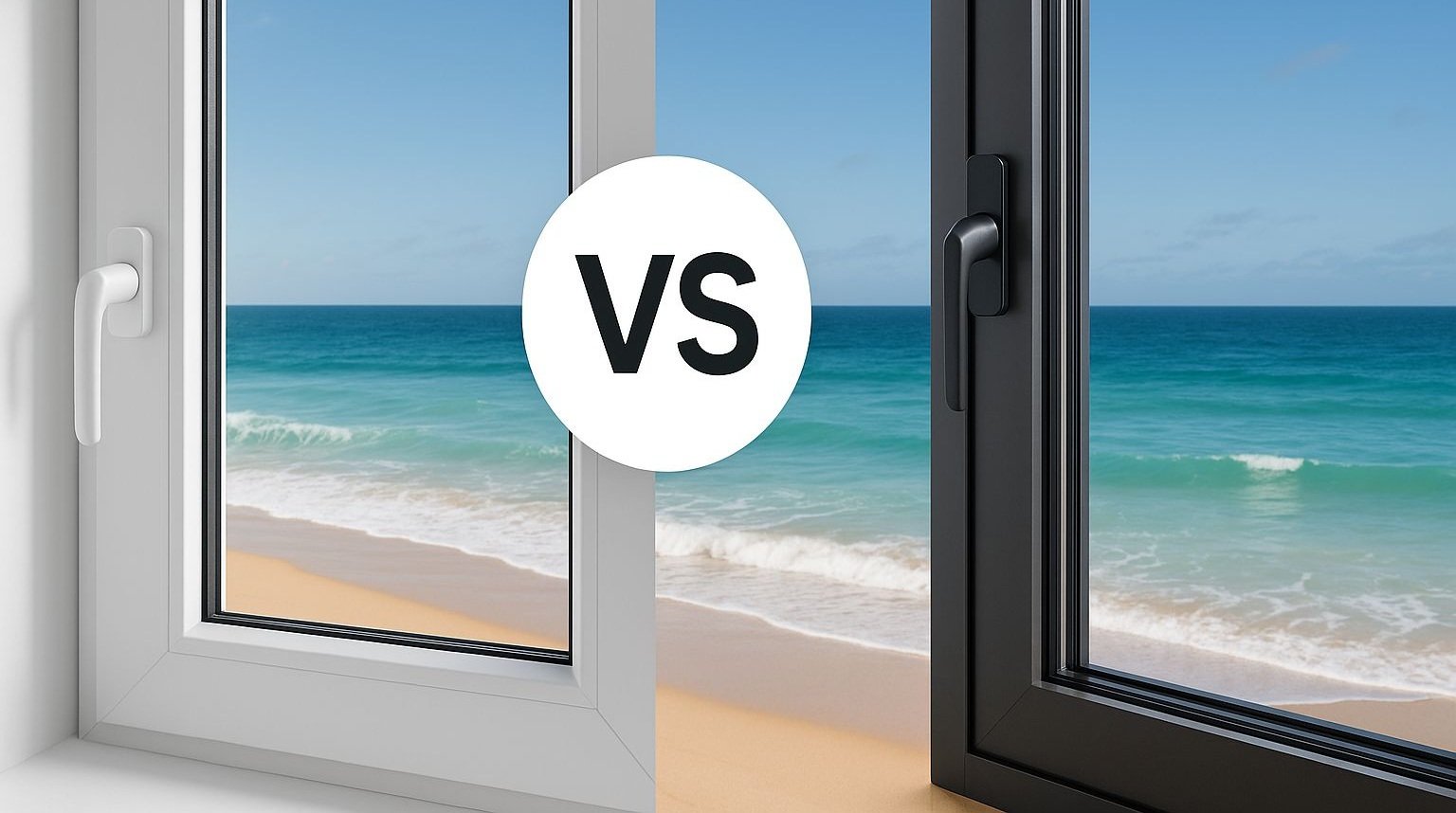
Choosing between uPVC and aluminium windows is an important decision when constructing a new house, renovating an existing property, building an apartment, or developing a commercial building in Odisha. Windows must withstand hot summers, monsoon rainfall, humidity, dust, wind and, in coastal areas, salt-laden air.
Odisha has diverse climatic conditions across its coastal plains, inland districts, northern plateau and southern highlands. Therefore, selecting windows according to local weather conditions, building orientation, ventilation requirements and budget is essential.
This comprehensive guide explains the differences between uPVC windows and aluminium windows, including their advantages, disadvantages, durability, thermal insulation, maintenance, cost factors, installation procedures and suitability across all 30 districts of Odisha.
uPVC stands for unplasticised polyvinyl chloride. It is a rigid polymer widely used for residential and commercial window frames.
Common uPVC window designs include sliding windows, casement windows, tilt-and-turn windows and fixed glass windows.
Main characteristics:
Good thermal insulation because uPVC has relatively low thermal conductivity.
Resistant to moisture and does not rust like metal.
Generally requires limited routine maintenance.
Available in different colours, finishes and frame designs.
Suitable for bedrooms, living rooms, kitchens, apartments and independent houses.
Performance depends on profile quality, reinforcement, glass, hardware and installation.
Aluminium windows use metal frames manufactured from aluminium profiles. They are commonly used in residential buildings, commercial properties, offices, showrooms and modern architectural projects.
Main characteristics:
Strong frames that can support large glazed openings when properly engineered.
Slim frame profiles for contemporary architectural designs.
Available in powder-coated and anodised finishes.
Suitable for sliding, casement, folding and fixed-window systems.
Require appropriate corrosion protection and hardware selection, particularly in coastal areas.
Thermal-break aluminium systems provide better insulation than conventional aluminium frames without thermal breaks.
Feature | uPVC Windows | Aluminium Windows |
|---|---|---|
Thermal insulation | Naturally good frame insulation | Thermal-break systems improve insulation |
Moisture resistance | Resistant to moisture and rust | Requires suitable finish and corrosion protection |
Coastal suitability | Suitable with quality profiles and hardware | Suitable with appropriate coatings and corrosion-resistant components |
Frame appearance | Usually thicker profiles | Often slimmer profiles |
Large glass openings | Depends on system design and reinforcement | Often suitable for larger openings |
Sound insulation | Depends on glazing, seals and installation | Depends on glazing, seals and installation |
Maintenance | Cleaning and hardware checks | Cleaning, hardware checks and finish inspection |
Design options | Sliding, casement and other systems | Sliding, casement, folding and other systems |
Colour options | White and various coloured or laminated finishes | Multiple powder-coated and anodised finishes |
Residential applications | Houses, apartments, bedrooms and kitchens | Houses, apartments, balconies and large windows |
Commercial applications | Suitable for many applications | Commonly used for offices, facades and showrooms |
Cost | Depends on profile, glass and hardware | Depends on profile, finish, glass and hardware |
The complete window system matters more than the frame material alone. When comparing quotations, check the glass specification, weather seals, hardware, drainage, structural suitability and installation quality.
Districts such as Puri, Balasore, Bhadrak, Kendrapara, Jagatsinghpur and Ganjam include coastal or near-coastal areas.
Important considerations include:
High humidity.
Wind-driven rain during the monsoon.
Salt exposure in locations near the sea.
Corrosion of unsuitable screws, hinges, locks and rollers.
Weather sealing and drainage.
uPVC can be a suitable choice because the frame does not rust. Aluminium can also perform well when supplied with appropriate protective finishes and corrosion-resistant hardware.
Bhubaneswar, Cuttack, Khordha and several other districts experience hot weather and seasonal humidity.
Consider the following:
Thermally insulating frame profiles.
Solar-control glazing where required.
Proper ventilation and shading.
Reliable perimeter sealing.
Suitable glass for west-facing and south-facing windows.
Districts in western Odisha, including Sambalpur, Balangir, Bargarh, Jharsuguda and Nuapada, can experience intense summer heat.
For these locations, evaluate uPVC or thermally broken aluminium alongside solar-control glass, external shading and building orientation.
Districts such as Koraput, Kandhamal, Gajapati and Rayagada have varied terrain and local climatic conditions.
Window selection should account for rainfall exposure, elevation, ventilation, temperature variation and the availability of maintenance services.
The following recommendations are general starting points. Actual specifications should be selected according to the property's precise location and exposure.
District | Climate and site factors | Window considerations |
|---|---|---|
Angul | Hot summers, dust and monsoon | Insulating uPVC or thermal-break aluminium |
Balangir | High summer temperatures and seasonal rain | Insulating frames and solar-control glass |
Balasore | Humidity, monsoon and coastal exposure in some areas | UV-stabilised uPVC or corrosion-protected aluminium |
Bargarh | Summer heat, dust and seasonal rain | Insulating profiles and appropriate glazing |
Bhadrak | Humidity, rainfall and coastal exposure in some areas | Weather-sealed uPVC or protected aluminium |
Boudh | Summer heat and seasonal rainfall | uPVC or thermal-break aluminium |
Cuttack | Heat, humidity and monsoon rainfall | Weather-resistant profiles and reliable drainage |
Deogarh | Inland weather and seasonal rainfall | uPVC or aluminium according to opening size |
Dhenkanal | Heat, humidity and monsoon | Insulating profiles and weather seals |
Gajapati | Hill terrain and rainfall variation | Weather-resistant systems and suitable glazing |
Ganjam | Coastal humidity and salt exposure in exposed areas | Coastal-suitable uPVC or protected aluminium |
Jagatsinghpur | Coastal humidity and wind-driven rain | Suitable profiles, hardware and perimeter sealing |
Jajpur | Summer heat, humidity and monsoon | uPVC or thermal-break aluminium |
Jharsuguda | Summer heat, dust and industrial exposure in some areas | Insulation and suitable finishes |
Kalahandi | Hot summers and seasonal rainfall | Insulating profiles and solar-control glazing |
Kandhamal | Hill conditions and rainfall | Weather-sealed uPVC or aluminium |
Kendrapara | Humidity and coastal or estuarine exposure in some areas | Coastal-suitable frames, fasteners and hardware |
Keonjhar | Inland and plateau conditions | uPVC or aluminium with suitable weather seals |
Khordha | Heat, humidity and seasonal rainfall | Insulating uPVC or thermal-break aluminium |
Koraput | Hill terrain and rainfall variation | Weather-resistant frames and appropriate glazing |
Malkangiri | Humidity, rainfall and hot seasons | Quality profiles, seals and drainage |
Mayurbhanj | Seasonal heat, rainfall and varied terrain | uPVC or aluminium according to exposure |
Nabarangpur | Summer heat, dust and monsoon | Insulating profiles and manageable maintenance |
Nayagarh | Heat, rainfall and local terrain | uPVC or thermal-break aluminium |
Nuapada | Summer heat and seasonal rainfall | Insulating profiles and solar-control glazing |
Puri | Coastal humidity, salt and wind-driven rain | Coastal-suitable uPVC or protected aluminium |
Rayagada | Hill terrain, rainfall and heat | Weather-sealed frames and suitable glazing |
Sambalpur | Intense summer heat and monsoon | Insulating profiles and solar-control glass |
Subarnapur (Sonepur) | Summer heat, dust and seasonal rain | uPVC or thermal-break aluminium |
Sundargarh | Inland weather and seasonal rainfall | Insulating uPVC or thermal-break aluminium |
uPVC casement windows can be useful when thermal insulation, ventilation and effective sealing are priorities. Aluminium casement windows are also suitable when slim profiles or a particular architectural finish is desired.
Large living rooms may benefit from sliding windows, fixed glass panels or casement windows, depending on the layout. Aluminium systems can be suitable for larger openings, provided the frame and glass are properly engineered.
Kitchen windows should provide ventilation, easy cleaning and practical access. Sliding and casement designs can both work, depending on the available space and kitchen layout.
Choose moisture-resistant frames, privacy glazing and a design that supports ventilation. Ensure that sill details and seals prevent water from entering the surrounding wall.
Sliding systems can be useful where outward-opening panels would obstruct the balcony. In exposed locations, check drainage, wind resistance, glass safety and weather-sealing performance.
Offices, shops, showrooms and other commercial properties may benefit from aluminium systems with slim sightlines and larger glass panels. The system should be selected according to the opening size, building height, wind exposure and intended use.
Window prices vary according to the manufacturer, profile series, glass, dimensions, opening style, colour, hardware, installation conditions and transport.
Instead of comparing prices without specifications, request a complete quotation covering:
Frame profile and material.
Glass thickness and type.
Hardware, locks, rollers and hinges.
Fabrication and assembly.
Installation and fixing materials.
Perimeter sealing and sill detailing.
Removal of old windows, if applicable.
Taxes, warranty and after-sales service.
The lowest quotation may not include the same glass, hardware or installation work as a more comprehensive quotation. Compare equivalent specifications before deciding.
Single glazing uses one pane of glass. It can be suitable for some standard applications and may have a lower initial cost, but generally offers less thermal and acoustic insulation than comparable double-glazed systems.
Double glazing uses two panes separated by a sealed gap. Depending on the design, it can improve thermal comfort and reduce outside noise.
For Odisha homes, consider double glazing when:
Rooms are air-conditioned for extended periods.
The property is near a busy road.
Windows receive substantial direct sunlight.
Improved indoor comfort justifies the additional investment.
Double glazing is not essential for every window. Solar-control glass, shading, ventilation and frame selection should also be considered.
1. Site measurement: Measure the window openings and inspect the surrounding masonry, sill and lintel.
2. Window selection: Confirm the material, frame profile, opening design, glass, hardware and colour.
3. Frame fabrication: Check the dimensions, squareness, joints and required reinforcement.
4. Frame positioning: Position the frame correctly and secure it with suitable anchors or brackets.
5. Glass and sash fitting: Install the glass panels, opening sashes and hardware according to the manufacturer's instructions.
6. Weather sealing: Use compatible sealant and appropriate flashing or sill details to manage rainwater.
7. Drainage inspection: Ensure drainage holes and tracks are free from obstruction.
8. Operational testing: Test opening, closing, locking and alignment.
9. Final inspection: Check for gaps, frame distortion, loose hardware and visible defects.
10. Handover: Provide warranty documentation and instructions for cleaning and maintenance.
For large windows, high-rise buildings and exposed coastal locations, use qualified installers and appropriate engineering specifications.
Selecting windows solely on the basis of price.
Ignoring coastal corrosion exposure.
Using unsuitable hardware or fasteners.
Blocking drainage holes with sealant or plaster.
Installing frames out of square.
Choosing inappropriate glass for large openings.
Neglecting sun exposure and ventilation.
Failing to check the installation warranty.
Assuming every window system is cyclone-proof or completely waterproof.
Neglecting regular cleaning and hardware maintenance.
The guide is relevant to construction and renovation projects in the following locations.
District or region | Example cities, towns and areas |
|---|---|
Khordha | Bhubaneswar, Jatni, Balianta, Balipatna, Khordha town |
Cuttack | Cuttack city, Choudwar, Athagarh, Banki, Salepur |
Puri | Puri, Pipili, Konark, Nimapada, Satyabadi |
Ganjam | Berhampur, Gopalpur, Chhatrapur, Hinjilicut, Asika |
Balasore | Balasore, Remuna, Soro, Jaleswar, Nilagiri |
Bhadrak | Bhadrak, Basudevpur, Chandbali, Dhamnagar |
Kendrapara | Kendrapara, Pattamundai, Aul, Rajnagar, Mahakalapada |
Jagatsinghpur | Jagatsinghpur, Paradip, Kujang, Tirtol, Ersama |
Jajpur | Jajpur, Vyasanagar, Chandikhol, Dharmasala, Sukinda |
Mayurbhanj | Baripada, Rairangpur, Karanjia, Udala, Betnoti |
Keonjhar | Keonjhar, Anandapur, Barbil, Joda, Champua |
Angul | Angul, Talcher, Banarpal, Chhendipada, Athmallik |
Dhenkanal | Dhenkanal, Kamakhyanagar, Bhuban, Hindol |
Sambalpur | Sambalpur, Burla, Hirakud, Rengali, Kuchinda |
Bargarh | Bargarh, Attabira, Padampur, Sohela, Barpali |
Jharsuguda | Jharsuguda, Brajarajnagar, Belpahar, Lakhanpur |
Sundargarh | Sundargarh, Rourkela, Rajgangpur, Biramitrapur |
Deogarh | Deogarh, Barkote, Reamal |
Balangir | Balangir, Titilagarh, Patnagarh, Kantabanji |
Subarnapur | Sonepur, Birmaharajpur, Tarbha, Binika |
Boudh | Boudh, Kantamal, Harabhanga |
Kalahandi | Bhawanipatna, Kesinga, Junagarh, Dharamgarh |
Nuapada | Nuapada, Khariar, Komna, Sinapali |
Nayagarh | Nayagarh, Daspalla, Ranpur, Khandapada |
Kandhamal | Phulbani, Baliguda, Daringbadi, G. Udayagiri |
Gajapati | Paralakhemundi, R. Udayagiri, Mohana |
Rayagada | Rayagada, Gunupur, Muniguda, Bissam Cuttack |
Koraput | Koraput, Jeypore, Sunabeda, Kotpad |
Malkangiri | Malkangiri, Balimela, Chitrakonda |
Nabarangpur | Nabarangpur, Umerkote, Raighar, Dabugam |
These are example locations, not a guarantee of service availability in every locality.
Both can be suitable. uPVC provides inherent frame insulation and moisture resistance, while aluminium can offer slim profiles and large openings. The appropriate choice depends on the building, exposure, glass and installation quality.
Yes. Quality uPVC systems can be suitable when their UV resistance, hardware, seals and drainage are appropriate for the location.
Aluminium does not rust like iron or steel, but it can corrode under certain conditions. Suitable finishes, compatible fasteners and regular inspection are important.
uPVC frames provide inherent insulation. Thermally broken aluminium can also improve insulation. Glass selection, shading, ventilation and window orientation influence indoor temperatures.
Both materials can provide good sound insulation when combined with suitable glass, effective seals and proper installation.
They can be suitable if the complete system is designed for the exposure and has correctly functioning tracks, drainage and weather seals.
Both materials are suitable for modern houses. Aluminium can provide slimmer profiles, while uPVC offers inherent frame insulation. Design, budget and performance requirements should guide selection.
Not for every property. Consider it for air-conditioned rooms, noisy surroundings and sun-exposed locations after comparing the additional cost and expected benefits.
Clean the frames and glass, clear drainage channels, remove dirt from tracks, inspect seals and service moving hardware according to the manufacturer's instructions.
Yes, in many cases. Inspect the opening, sill, lintel and surrounding masonry before installing replacement frames.
Check profile quality, glass specifications, hardware, weather performance, installation scope, warranty and replacement-part availability.
No. Cyclone resistance depends on the tested or engineered performance of the complete assembly, including glass, frame, anchors and supporting structure. Obtain suitable professional advice for exposed locations.
Choosing between uPVC and aluminium windows in Odisha requires consideration of local climate, building orientation, window dimensions, thermal comfort, maintenance and budget.
For many residential properties, uPVC is worth considering for insulation and low routine maintenance. Aluminium is worth considering for slim sightlines, contemporary designs and larger glass openings. Both require appropriate glazing, weather seals, drainage and professional installation.
Before making a final decision, compare complete quotations and confirm that the proposed window system suits the property's actual weather exposure.


Information 5 min read
Read →
Information 5 min read
Read →
Guide 5 min read
Read →
Tips 5 min read
Read →
Tips 5 min read
Read →
Guide 5 min read
Read →
Guide 5 min read
Read →
Information 5 min read
Read →
Information 5 min read
Read →
Guide 5 min read
Read →
Guide 5 min read
Read →
Guide 5 min read
Read →
Guide 5 min read
Read →
Analysis 5 min read
Read →
Information 5 min read
Read →
Tips 5 min read
Read →
Guide 5 min read
Read →
Guide 5 min read
Read →
Guide 25 min read
Read →
Guide 5 min read
Read →